Review of Sonóir, Harp Ireland Gala Concert on JMI
Brendan Finan reviews Sonóir at the RIAM in the Journal of Music Ireland
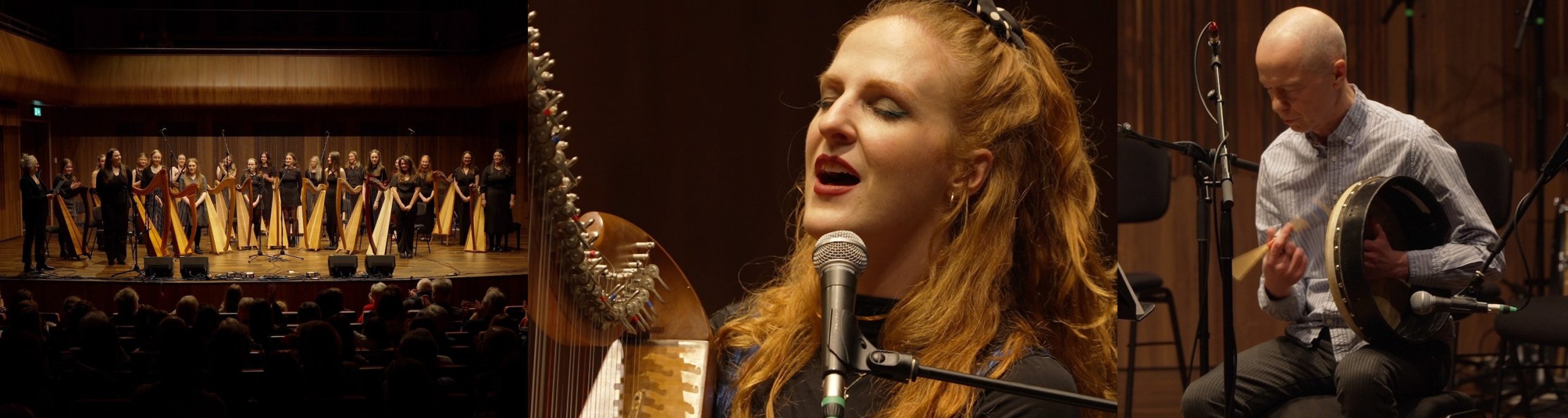
Cruit Éireann | Harp Ireland held its annual gala concert on 30 November at the Whyte Recital Hall, featuring new music by Mel Mercier, arrangements by Michael Rooney for the 25-member All-Island Harp Ensemble, and performances by Cormac de Barra and Anne-Marie O’Farrell as well as the Lisa Canny Band.
https://journalofmusic.com/reviews/four-worlds-irish-harp
I took great pride, in a past life as an English teacher, in telling my students that of all the nations on earth, Ireland alone bore a musical instrument as its national symbol. It’s easy to forget, as we see it often enough that we stop noticing it, on envelopes from government offices and on the backs of coins. But it’s a unique feature of the country and a reminder of the centrality of our musical heritage. So it’s appropriate to celebrate the harp, as Cruit Éireann did in its annual gala concert at the Whyte Recital Hall at the Royal Irish Academy of Music, Dublin, on Sunday evening (30 Nov.). The programme, introduced by Ellen Cranitch, showcased nothing more than the versatility of the Irish harp, with four performances in four totally different styles. These included premieres of new music by Mel Mercier and Michael Rooney, bookended by performances by Cormac de Barra and Anne-Marie O’Farrell at the beginning and the Lisa Canny Band at the end.
Rooney’s ‘Ansáil Ársa na Seanmhaoine’ was primarily free arrangements of three tunes collected by Edward Bunting in 1796 – Thomas Connellan’s ‘Síle Ní Chonalláin’, Turlough Carolan’s ‘Lady St John’, and ‘An bhfaca tú an stáraí dubh’, which Bunting heard from Hugh Higgins – for the Cruit Éireann All-Island Harp Ensemble, led by Síofra Ní Dhubhghaill. Twenty-five harps playing together, sometimes in unison, others in smaller groups, sound like nothing else. In the same manner of an orchestral violin section, the predominant feature is not one of amplification but of concordance. The instruments playing together produce a sound that is louder than a single harp, yes, but more importantly timbrally distinct.
Rooney’s arrangements of the three tunes were compelling also. Writing for an ensemble of the same instrument is quite different from writing for varied forces, and no specific section is assigned to upper or lower playing. With a group this large spanning the stage – Cranitch quipped that there were some 900 strings tuned before the performance – passing a melody from one section to another felt like stereo panning. It also allowed for some nice effects impossible (or at least highly impractical) on a single harp – a key change at the beginning of ‘An bhfaca tú an stáraí dubh’ accomplished by having one group of performers ready to begin in the higher key, waiting for the moment of the gear change.
Sonóir
Mel Mercier’s new work, Sonóir, also focuses on harps, played by Niamh O’Brien and Alannah Thornburgh, but it was the first to feature other instruments: the duo were joined by viola da gamba played by Malachy Robinson and bassoon by Sinéad Frost, along with Mercier himself on percussion. This highly unusual combination proved compelling right from the bouncy opening, with the gamba, played pizzicato, matching the bassoon’s earthiness alongside a steady pulse on bones. The harps then joined with complex, quirky arpeggios not too far in feel from a reel.
Sonóir draws on the air ‘An raibh tú ar an gcarraig?’, though by Mercier’s admission the tune is so fully subsumed as to be practically inaudible in the resulting work. There is an unmistakable air of Irish dance music in the harmony and melodic feel, particularly in the early segments. The work is somewhat episodic, but with a good sense of overall direction. A lot of its development is rhythmic, and Mercier showed a skill in creating rhythms tricky to execute while always sounding natural – an extremely easygoing passage in 5/4, or a set of layers built on an insistent and disorienting ‘tock-tick-tick’ rhythm on the bones. With these sorts of rhythmic games, the work was fun – equally so the ending, which felt abrupt enough to take me by surprise in the moment, but which in retrospect was exactly right.
Moments of virtuosity
The concert’s opening and closing performances were even more diverse. The beginning, a set by Cormac de Barra and Anne-Marie O’Farrell, saw the pair exploring their range of proficiencies, from baroque to sean-nós, and a range of tunes from original compositions to the Welsh tune ‘Watching the Wheat’, which O’Farrell had learned from her teacher. The performance featured several moments of virtuosity – quick arpeggios, flawless harmonics, rapid-fire lever changes – as well as some simple but fun effects, like when O’Farrell reached behind her and pulled out a small plastic motor fan that she used to create a single-string drone to accompany de Barra’s singing.
The Lisa Canny Band
After the interval came a second highly-unusual-yet-effective instrumental combination, with the Lisa Canny Band performing on vocals and harp (Canny), drums (Tod Doyle), bass (Niall Hughes), and fiddle (Laura Doherty). This also transpired to be, after fifteen years playing together, the band’s last performance for the foreseeable future, as Canny’s group BIIRD is seeing success internationally, and touring with Ed Sheeran next year, putting the kibosh on other projects. The primary drive of their sound is popular music, but popular with its roots very much in the traditional world. Their set showed an impressive range, from Canny’s LA pop fairytale ‘Julie’ to a solo harp version of ‘The Road to Corrandulla’ with an improvised finale to her own ‘Canny’s Fancy’, featuring a lovely dialogue between harp and fiddle.
Appropriately for the RIAM venue, the importance of legacy, of passing the harping tradition from teacher to student, was a recurring theme throughout the concert. O’Farrell, Mercier and Canny all spoke effusively on the influence of their teachers on their work, and on the centrality of mentorship in growing the tradition. But at the heart of the event was the instrument, so many centuries associated with this country; this tool of wood and wire proving its worth and versatility still.